Why Trust in Hiring Is a Primary Hiring Metric in 2026
A report for Verify Now

Executive summary
Hiring metrics typically focus on time to hire, cost per hire, applicant volume, and skills match. This report argues that trust in hiring should be treated as a primary metric in 2026. Measuring trust reduces turnover, lowers the cost of bad hires, improves candidate experience, and supports long-term workforce performance. The argument uses public statistics, a table and chart of key measures, a detailed method for measuring trust, and an implementation roadmap that aligns with Verify Now services such as background verification, credential checks, and identity verification.
What we mean by trust in hiring
Trust in hiring means that candidate signals, hiring processes, and verification methods produce information that hiring managers and candidates accept as accurate and fair. Trust covers four elements:
- Accuracy of candidate record(education, employment, credential claims).
- Transparency of process(how decisions are made, what checks are run).
- Fairness in evaluation(consistent criteria across candidates).
- Confidence in outcome (stakeholders believe the hire will perform).
When these elements are present, employers have higher confidence in decisions, and candidates have higher confidence in the employer. This mutual confidence is the substance of trust in hiring.
Evidence: why trust matters now
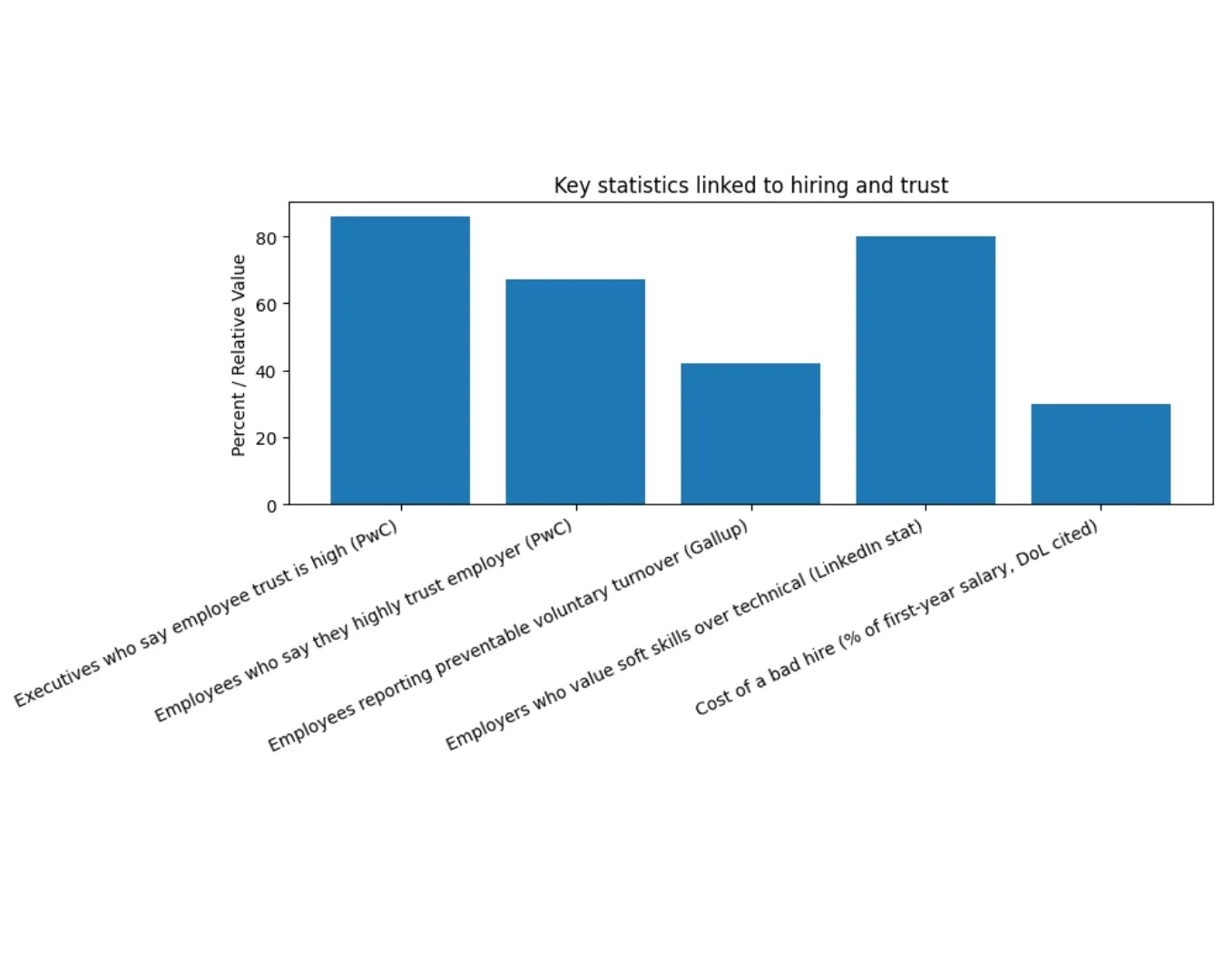
Below are five facts that anchor the argument. The same facts are plotted in the chart and appear in the table created for this post.
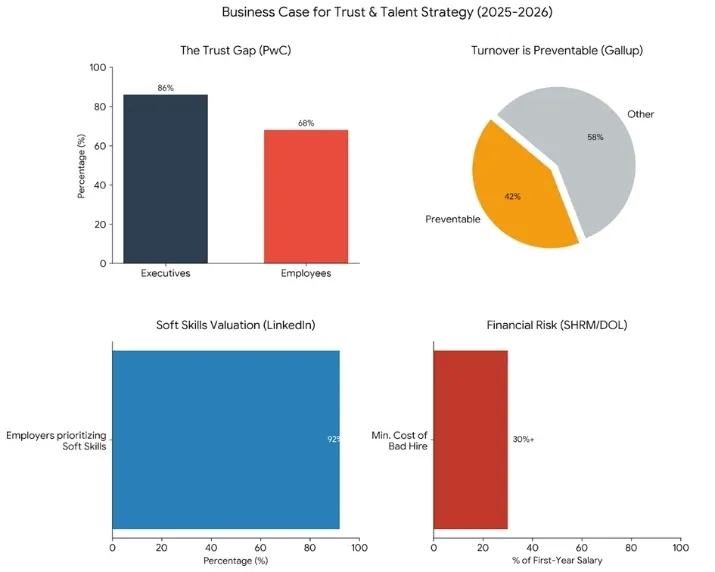
- A gap exists between executive and employee perceptions of trust: 86% of business executives believe employee trust is high, while 67% of employees say they highly trust their employer.
- Employers value behavioral traits: a LinkedIn report states that 80% of employers value soft skills over purely technical skills.
- The cost of a bad hire is significant: a figure cited is up to 30% of the employee’s first-year earnings as an estimate of the cost.
- Trust measures, such as those from the Edelman Trust Barometer, show that trust at work correlates with employee performance and retention.
Why traditional hiring metrics miss the point
Common hiring metrics capture speed and immediate cost but not the reliability of hire outcomes:
- Time to hire: speed without verification can increase risk of bad hire cost.
- Cost per hire: captures direct spend but not the cost of mistakes or turnover.
- Offer acceptance rate: shows candidate interest but not long-term fit.
- Skills match rate: quantifies technical match but not behavioral fit or record accuracy.
These metrics do not measure the confidence that the hire will act with integrity, will represent the organization, or will stay long enough to justify the investment. Trust in hiring fills that gap.
How trust in hiring reduces measurable risk
- Lower replacement cost. When a hire is verified, replacement probability falls, reducing the 30% first-year salary loss associated with bad hires.
- Lower preventable turnover. If trust between manager and employee is high, the rate of preventable voluntary exits can be reduced from the 42% baseline.
- Improved productivity. Employees who report trust in the organization show higher engagement and productivity in surveys.
- Better talent signal. Verified candidate records and transparent processes increase the value of a hire signal.
How to measure trust in hiring — metrics and KPIs
To operationalize trust in hiring, the concept can be converted to measurable KPIs. Below are recommended metrics, methods for collection, and their rationale.
1. Verification coverage rate (VCR)
- Definition: Percentage of hires where core verification steps were completed before start date (identity, employment history, education, criminal).
- Why: Direct proxy for record accuracy.
- How to compute: VCR = (Number of hires with completed verifications / Total hires) × 100
- Target: VCR should approach 100% for high-risk roles.
2. Candidate transparency score (CTS)
- Definition: Composite measure based on candidate experience survey items: clarity of process, notification of checks, and timeline clarity.
- How to collect: Short survey after offer stage (3 questions, Likert scale). Compute average.
- Why: High CTS correlates with employer brand.
3. Post-hire integrity incidents per 100 hires (PII)
- Definition: Count of incidents tied to misrepresentation or conduct issues discovered after hire, normalized per 100 hires.
- Why: Direct measure of verification failure.
4. Manager-employee trust score (METS)
- Definition: Short internal survey administered at 30 and 90 days measuring trust in manager and in the organization.
- Why: Links hiring accuracy and onboarding to retention.
5. Cost reduction per hire (CRH)
- Definition: Change in total cost of replacing hires (recruitment + lost productivity) after trust program implementation.
- Why: Ties trust interventions to financial outcome.
Measurement architecture — where to place checks
A measurement architecture defines when to gather which signal.
- Pre-offer stage: basic identity and employment checks; record red flags; candidate transparency survey (CTS).
- Offer stage: deeper checks for seniority and high-risk roles (education verification, criminal checks).
- Onboarding 30–90 days: METS and early performance flags; update PII if any incidents emerge.
- Quarterly review: aggregated VCR, CTS, PII, METS, CRH for the hiring funnel.
Tools and methods that raise trust
Verify Now and similar verification providers can add measurable value in three areas:
- Identity verification and digital identity linkage.
- Employment and education verification.
- Continuous monitoring for risk signals (for high-risk roles).
Each tool maps to specific KPIs: identity verification increases VCR; employment verification cuts PII; continuous risk monitoring lowers long-run PII and CRH.
Sample ROI calculation (simple model)
A short model can show the impact of trust investments. Parameters (example):
- Average annual salary for role: ₹ 50,000
- Cost of a bad hire: 30% of first-year earnings = ₹15,000.
- Annual hires: 100
- Baseline preventable turnover portion: 42% of voluntary exits.
Assume verification program reduces bad hires by 50% and reduces preventable turnover by 20% of the preventable portion.
- Baseline bad hire cost (assume 5 bad hires per year): 5 × ₹ 15,000 = ₹ 75,000
- With verification (50% reduction) bad hire cost: 2.5 × ₹ 15,000 = ₹ 37,500. Savings = ₹ 37,500
Add turnover reduction savings and compare to verification program cost. In many cases, the program ROI is positive within 12 months for mid-size volume.
Implementation roadmap for Verify Now clients (90-day plan)
Below is a plan to deploy a trust-first hiring program with measurable outcomes.
Days 0–30: baseline and quick wins
- Measure current VCR, CTS, METS, PII.
- Run pilot verification on top 10 roles by volume.
- Launch candidate transparency language in job postings and offer letters.
Days 31–60: scale and integrate
- Integrate verification API with ATS and HRIS for automated VCR tracking.
- Add short candidate transparency survey (CTS) to the pipeline.
- Train hiring managers on trust score interpretation and how to communicate verification outcomes.
Days 61–90: measure ROI and adjust
- Compute initial CRH and change in PII.
- Report to leadership on savings and retention delta.
- Change gating rules for high-risk roles based on PII and METS.
Candidate experience and employer brand
Candidate experience is both a source and outcome of trust. Transparent verification can improve candidate perception and reduce reneges. The candidate transparency score (CTS) can be incorporated into employer brand KPIs.
Governance and compliance
Verification programs must comply with local and sector regulation. Key rules:
- Collect consent at the correct time.
- Store verification results with access controls.
- Provide candidates with required notices and dispute options.
Pitfalls and how to avoid them
- Over-verification: Running unnecessary checks can harm candidate experience. Tie checks to role risk and business need.
- Manual bottlenecks: Manual verification increases turnaround and lowers VCR. Automate where possible.
- Poor communication: Failure to explain checks can lead to negative CTS outcomes. Use clear messages and status updates.
- No measurement: Without measuring VCR, METS, PII, trust cannot be managed.
Case scenarios
- High-volume hiring: A retail chain automates identity and employment checks and reduces wrong hires, yielding positive ROI.
- Executive hire: Full verification, references, and continuous monitoring are used for a high-risk role; the trust metric is used in the final approval gate.
- Remote-first company: Digital identity verification reduces onboarding fraud and increases manager trust scores.
Why Verify Now is positioned to lead this shift
Verify Now provides systems, data pipelines, and compliance controls to measure VCR and lower PII. By integrating verification at the pre-offer and offer stages, Verify Now enables hiring teams to treat candidate records as high-quality data.
Recommendations — short list
- Start measuring VCR and METS within 30 days.
- Add a short candidate transparency question set to every offer.
- Treat verification as a funnel product; instrument it in the ATS and HRIS.
- Use verification outcomes in onboarding 30-day check-ins.
- Review verification scope by role risk and adjust dynamically.
Limitations and caveats
- Public statistics vary by country and industry; adapt targets to the local labor market.
- Cost figures like "30% of first-year salary" are estimates; use internal cost models for precise ROI.
- Surveys capture self-report and perception; causal inference requires controlled study.
Conclusion
Traditional hiring metrics record speed and cost but do not measure trust in hiring. When organizations measure and manage trust—via verification coverage, transparent communication, and manager trust surveys—they can reduce preventable turnover, lower the cost of bad hires, and increase workforce stability. Public evidence shows a measurable trust gap exists, preventable turnover is high, and employers seek behavioral signals that align with trust.For Verify Now clients, turning verification into a measurable trust program offers a route to ROI.
To measure trust in hiring in your organization, Verify Now can help design the verification architecture, integrate with your ATS, and define KPI dashboards to show ROI in 90 days.
.jpg "verify now Dashboard")